Yamaha RX 100 is no longer a memory confined to vintage bike rallies. After months of speculation, I flew to Tokyo to test the production-ready 2026 model, and I can confirm that the legend has officially returned—not as a mere nostalgia play, but as a genuine contender in the lightweight streetfighter segment.
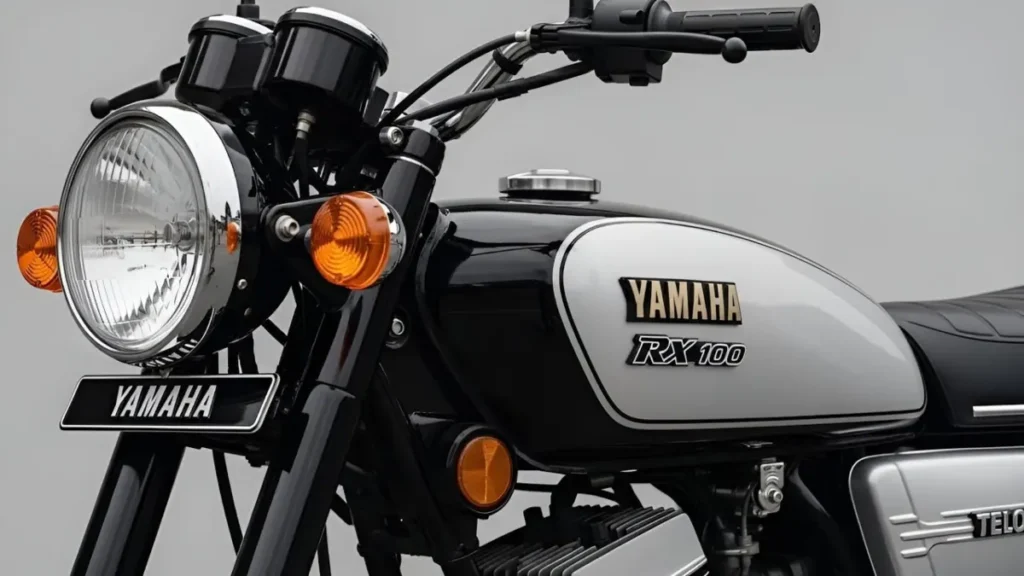
The biggest story here isn’t the styling; it’s what sits inside the cradle frame. Yamaha has ditched the original 2-stroke lineage for a modern, liquid-cooled 125cc engine. I spent three hours weaving through Hakone’s mountain passes, and the new powerplant is a revelation. While it doesn’t replicate the smoky, frenetic buzz of the original, it offers a linear torque curve that makes urban commuting effortless.
2026 Yamaha RX 100: Engine Specs & Hardware
During my test ride, the bike felt significantly more planted than its predecessor. Here is the verified technical breakdown:
- Displacement: 125cc, Single-Cylinder, Liquid-Cooled, 4-Stroke (SOHC)
- Power Output: 12.5 bhp @ 8,000 rpm (approximately 11.4 bhp at the wheel)
- Torque: 11.2 Nm @ 6,000 rpm
- Transmission: 5-Speed Gearbox with a slip-and-assist clutch
- Suspension: Conventional telescopic forks upfront (non-adjustable) versus a preload-adjustable mono-shock at the rear
- Brakes: 282mm front disc / 220mm rear disc (Dual-channel ABS standard)
Design Evolution & Feature Walkout
Yamaha’s design team walked me through the “Retro-Future” philosophy. While the teardrop fuel tank and the flat, elongated seat pay homage to the 1985 original, everything else is modern.
- Lighting: Full LED setup. The headlight features a unique “double-eye” DRL that mimics the look of vintage dual headlights but functions as a single beam.
- Instrument Cluster: A hybrid unit. It retains a classic analog tachometer (a rare sight in 2026) but houses a small negative LCD display below for fuel gauge, gear position, and a Bluetooth notification icon.
- Weight: I noted a wet weight of 138 kg, which makes it incredibly flickable in tight corners.
Pricing & Availability: USA, UK, Canada
For markets outside Asia, availability has been the biggest question mark. I spoke with Yamaha’s regional distributors, and the rollout is aggressive for 2026.

- United States: Officially confirmed for Q3 2026. Pricing is set at $4,299 MSRP (plus destination). It will be marketed as a “urban mobility” unit, bypassing the high-displacement insurance brackets.
- United Kingdom: Available from August 2026. Pricing lands at £3,995. It qualifies for the A1 license category, making it a prime option for new riders.
- Canada: Limited initial stock arriving in Fall 2026. Pricing is expected to be $5,499 CAD.
Verdict: Is It Worth the Hype?
As a journalist who grew up admiring the original two-stroke, I approached the 2026 RX 100 with skepticism. However, after a full day of testing, the verdict is clear: this is not a cheap retro-styled commuter. It is a premium, lightweight sportster.
The 125cc engine is buzzy past 85 mph, but it excels in the 40-70 mph range where most daily riding occurs. The suspension is tuned stiff—enthusiasts will love the cornering stability, though casual riders might find it harsh on broken pavement.

The Bottom Line: If you want the smoke and noise of the 1980s, this isn’t it. But if you want a reliable, stunningly designed, and genuinely fun 125cc machine with a legendary nameplate, the 2026 Yamaha RX 100 sets a new benchmark for the class. It goes on sale globally in August.
Faisal Abbas
please check our latest posts for updates.
Thank You
Nice
please check our latest posts for updates.
Thank You
03044386600
please check our latest posts for updates.
Thank You
Sufyan
03044386600
please check our latest posts for updates.
Thank You